15. Ceremonies
Every ceremony in Dandori must earn its place by addressing a specific failure mode. If it does not prevent a real problem, it is waste.
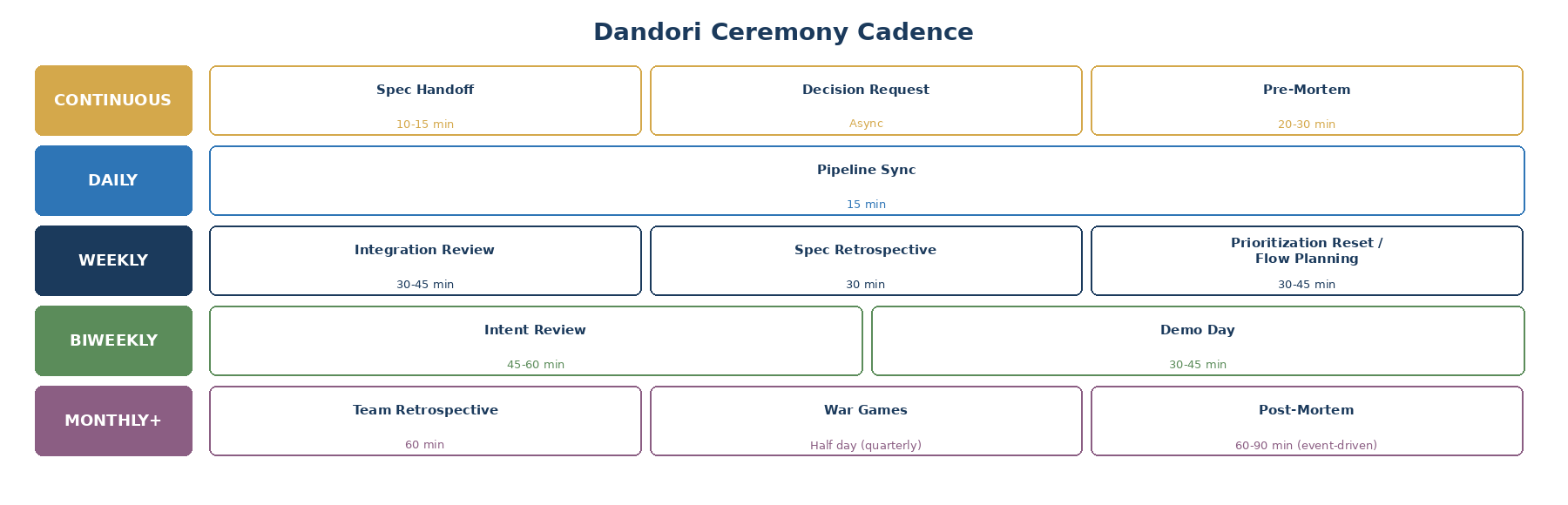
Ceremony Classification
Not every ceremony is mandatory at all times. Teams should start with all ceremonies active and earn the right to reduce frequency or omit based on data.
| Tier | Ceremony | When Reducible | What Breaks Without It |
|---|---|---|---|
| Non-Negotiable | Pipeline Sync | Never | Specs pile up unnoticed. Flow stops. |
| Spec Handoff | Never | Reviewers misunderstand intent. | |
| Integration Review | Can shorten to 30 min | Architectural drift goes undetected. | |
| Required, Frequency Adapts | Spec Retrospective | Biweekly when first-pass >75% | Spec quality stops improving. |
| Prioritization Reset | Biweekly when queue is stable | Queue becomes stale. | |
| Conditionally Required | Pre-Mortem | Only Complex/Uncertain specs | High-risk specs enter execution with unexamined assumptions. |
| Decision Request | Triggered by need | Specs encode wrong decisions. | |
| Intent Review | Pause when team is small, domain is well-understood | Shared context degrades. | |
| Earned Optional | Team Retrospective | Quarterly after 6 months stable | Human side goes unprocessed. |
| Demo Day | Monthly or pause during low-output | Human contribution becomes invisible. | |
| War Games | Semiannual for stable systems | Systemic interaction risks undetected. | |
| Event-Driven | Post-Mortem | Cannot omit when triggered | Root causes go unexamined. |
Principle: start with everything, reduce based on evidence. Dropping a ceremony because "we're too busy" is avoidance. Dropping it because your metrics justify it is earned confidence.
Continuous Ceremonies
Spec Handoff (10-15 min per spec): Spec Owner walks the Reviewer through the spec before AI execution begins. Prevents the most expensive failure: correct AI execution of a misunderstood spec.
Decision Request (async, 4-24hr SLA): Structured request when a Spec Owner hits ambiguity. Format: what decision is needed, options, recommendation, what is blocked.
Pre-Mortem (20-30 min, high-risk specs): Team assumes AI executes the spec perfectly and asks what could still go wrong.
Daily Ceremony
Pipeline Sync (15 min): Tracks specifications, not people. What moved forward, what is stuck, where is the highest-priority unblocked work.
Weekly Ceremonies
Integration Review (30-45 min): What shipped, what patterns emerge in spec success and failure, architectural coherence check.
Spec Retrospective (30 min): How do we write better specs? Categorize failures, identify actionable improvements.
Prioritization Reset / Flow Planning (30-45 min): Re-rank intent queue, assess capacity, triage new intents with Specifiability Classification.
Biweekly, Monthly, Periodic, and Event-Driven
Intent Review (45-60 min, biweekly): Full team reviews upcoming intents for shared context-building.
Team Retrospective (60 min, monthly): The human-centered ceremony addressing feelings, identity, and sustainability.
Demo Day (30-45 min, biweekly/monthly): Cultural ceremony showcasing the spec-to-outcome journey.
War Games (half day, quarterly): Stress-test systemic interactions between independently correct specs.
Post-Mortem (60-90 min, event-driven): Root cause analysis explicitly asking: was this a spec failure, AI execution failure, validation failure, or operational failure?