Capstone - Multi-Agent Delivery Workflow
Build a workflow that coordinates specialist agents to plan, review, and package a delivery artifact while preserving one accountable owner for final acceptance.
This capstone is coordination heavy. The lesson is that multiple agents do not remove the need for workflow ownership. They increase the need for it.
Problem
A team wants an agentic workflow that turns a product request into a reviewed delivery package: requirements summary, implementation plan, risk review, test plan, and final release note. Specialist agents can help, but the workflow must prevent duplicated work, conflicting outputs, unclear authority, and unreviewable transcripts.
Non-Goals
- Do not let agents merge their own outputs without a final owner.
- Do not treat role names as specialization.
- Do not use chat history as the only state store.
- Do not allow tools without role-specific permissions.
Pattern Composition
| Concern | Pattern |
|---|---|
| decomposition | Task Delegation |
| coordination | Supervisor / Worker |
| role workflow | CrewAI Flows and Crews |
| transcript review | Observability and Evals |
| durable state | Durable Workflows |
| production runtime | Deployment Walkthrough |
Architecture
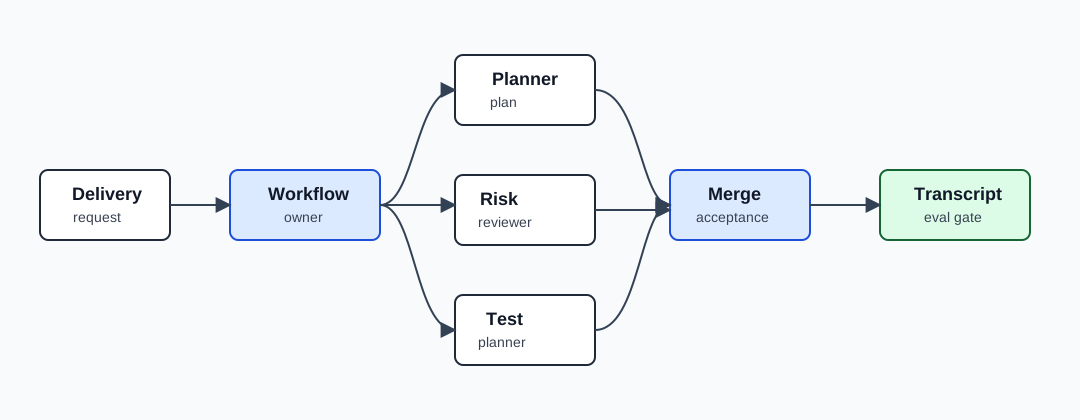
Read this diagram as an accountability boundary. Specialist agents contribute work, but the workflow owner keeps state, merges outputs, runs evals, and accepts the final package.
Runnable Assets
Run the deterministic capstone implementation:
npm run capstones:demo
npm run capstones:test
Inspect:
capstone-projects-runtime/typescript/src/capstones.tscapstone-projects-runtime/typescript/test/capstones.spec.ts
Downloadable evidence:
- Sample trace JSON
- Sample eval report
- Capstone review scorecard
- Framework selection ADR template
- Production readiness worksheet
Expected runtime signal:
multi-agent-delivery-workflow: pass
  stop: accepted_after_review
  trace events: 4
The test suite treats these as release evidence:
| Evidence | Runtime Check |
|---|---|
| Planner output exists | planner_present |
| Risk review exists | risk_review_present |
| Test plan exists | test_plan_present |
| Turns are ordered | turns_sequential |
| Workflow owner accepts last | final_owner_accepts_last |
| Release gate emits one final decision | delivery_workflow_release_gate |
Role Contracts
| Role | Input | Output | Cannot Do |
|---|---|---|---|
| Planner | request, constraints | scoped implementation plan | approve final release |
| Risk reviewer | request, plan | risks, mitigations, blockers | rewrite plan silently |
| Test planner | request, plan | test matrix and gates | lower release threshold |
| Workflow owner | all outputs | final accepted package | ignore failed evals |
Every role needs a reason to exist. If a role does not change the output or risk profile, remove it.
Capstone Review Gate
Before treating this capstone as production-grade, verify the accountability boundary:
| Check | Evidence |
|---|---|
| One owner accepts final output | Workflow owner, not a worker agent, sets final acceptance. |
| Roles are distinct | Planner, reviewer, and tester have different inputs, outputs, and limits. |
| Transcript is normalized | Messages include role, turn, type, task, stop reason, and eval result. |
| Missing review blocks release | Risk review and test plan are required before acceptance. |
| Delegation can be disabled | Rollback routes work to a single-owner checklist workflow. |
Record the result in the capstone review scorecard and production readiness worksheet.
Production Bridge
Use this table when turning the capstone into a service:
| Capstone Artifact | Production Version |
|---|---|
| Role contracts | Versioned role schemas with permissions, tool scopes, timeouts, and expected outputs. |
| Workflow owner | Durable acceptance step with final owner, stop reason, and rollback control. |
| Transcript example | Redacted transcript store with replay, retention, and incident links. |
| Transcript evals | Blocking gates for role coverage, turn order, final owner, and ignored blockers. |
| Runbook | Kill switch for delegation plus fallback checklist path. |
The first production milestone is a delivery workflow that can reject incomplete collaboration and prove who accepted the final package.
Native Framework Mapping
Start with the deterministic TypeScript capstone, then compare the native slices:
native-framework-examples/crewai-delivery/proves role separation and flow-owned acceptance before adding real project-management or repository tools.native-framework-examples/autogen-delivery/proves AgentChat team roles, termination, normalized transcript export, and transcript evals.
| Framework | Best Mapping |
|---|---|
| CrewAI | Flow owns state and final acceptance. Crew agents produce planner, reviewer, and tester outputs. |
| AutoGen | AgentChat team records role turns and termination. Transcript evals check role order and stop reason. |
| LangGraph | Nodes or subgraphs represent roles. Graph state stores each output and final acceptance. |
| Mastra | Workflow coordinates agents, tools, evals, and trace export inside a TypeScript runtime package. |
| Mini-runtime | Supervisor dispatches tasks, validates worker outputs, merges results, and emits trace events. |
Trace And Transcript Example
{
  "trace_id": "tr_delivery_331",
  "workflow_state": "accepted",
  "messages": [
    { "turn": 1, "from": "workflow", "to": "planner", "type": "assignment" },
    { "turn": 2, "from": "planner", "to": "workflow", "type": "plan" },
    { "turn": 3, "from": "workflow", "to": "risk_reviewer", "type": "review_request" },
    { "turn": 4, "from": "risk_reviewer", "to": "workflow", "type": "risk_review" },
    { "turn": 5, "from": "workflow", "to": "test_planner", "type": "test_request" },
    { "turn": 6, "from": "test_planner", "to": "workflow", "type": "test_plan" },
    { "turn": 7, "from": "workflow", "to": "team", "type": "accepted_package" }
  ],
  "evals": [
    { "case_id": "planner_present", "status": "pass" },
    { "case_id": "risk_review_present", "status": "pass" },
    { "case_id": "test_plan_present", "status": "pass" },
    { "case_id": "turns_sequential", "status": "pass" },
    { "case_id": "final_owner_accepts_last", "status": "pass" }
  ]
}
Eval Report Example
| Case | Expected | Result |
|---|---|---|
planner_present |
Planner returns an implementation plan. | pass |
risk_review_present |
Risk reviewer returns review output before acceptance. | pass |
test_plan_present |
Test planner returns test gates before acceptance. | pass |
turns_sequential |
Transcript turns are 1 through 7 with no gaps. | pass |
final_owner_accepts_last |
The workflow owner sends accepted_package last. |
pass |
| reviewer finds blocker | Workflow stops or escalates. | blocking |
| tester missing | Final acceptance is blocked. | blocking |
Blocking threshold:
required role coverage: 100%
final owner present: 100%
critical blocker ignored: 0
missing test gate accepted: 0
ADR Example
# ADR-023: Delivery workflow uses specialist agents with workflow-owned acceptance

## Status

Accepted

## Decision

The delivery workflow may delegate planning, risk review, and test planning to specialist agents. A workflow-owned acceptance step decides the final package. Worker agents cannot approve release, lower gates, or mutate final state directly.

## Rollback

Disable multi-agent delegation and route requests to a single deterministic checklist workflow until transcript evals and role boundaries pass.
Runbook Example
service: multi-agent-delivery-workflow
owner: platform-engineering
kill switch: disable delegation
fallback: single-owner delivery checklist
trace dashboard: platform/delivery-workflow/traces
eval suite: evals/delivery-workflow
incident trigger: final package accepted without risk review, test plan, or owner
post-incident action: add transcript regression fixture and update role contract
Release Checklist
- Workflow state is separate from role chat.
- Every role has a typed input and expected output.
- Tool permissions are role-specific.
- Merge and acceptance are explicit workflow steps.
- Transcript evals verify order, role coverage, and stop reason.
- Rollback can disable delegation without disabling the whole delivery workflow.
Related Labs
- Lab 05 - Multi-Agent Supervisor
- Lab 08 - CrewAI Flows and Crews
- Lab 12 - LangGraph State Graph
- Lab 13 - AutoGen Transcript Evals
Native examples: