Release Readiness Checklist
Use this checklist before publishing a new version of the book. The standard is not “the site builds.” The standard is that a reader can move from concept, to pattern choice, to lab, to capstone, to release evidence without finding missing context.
Download the reusable publishing artifact: release evidence record.
Verification Coverage
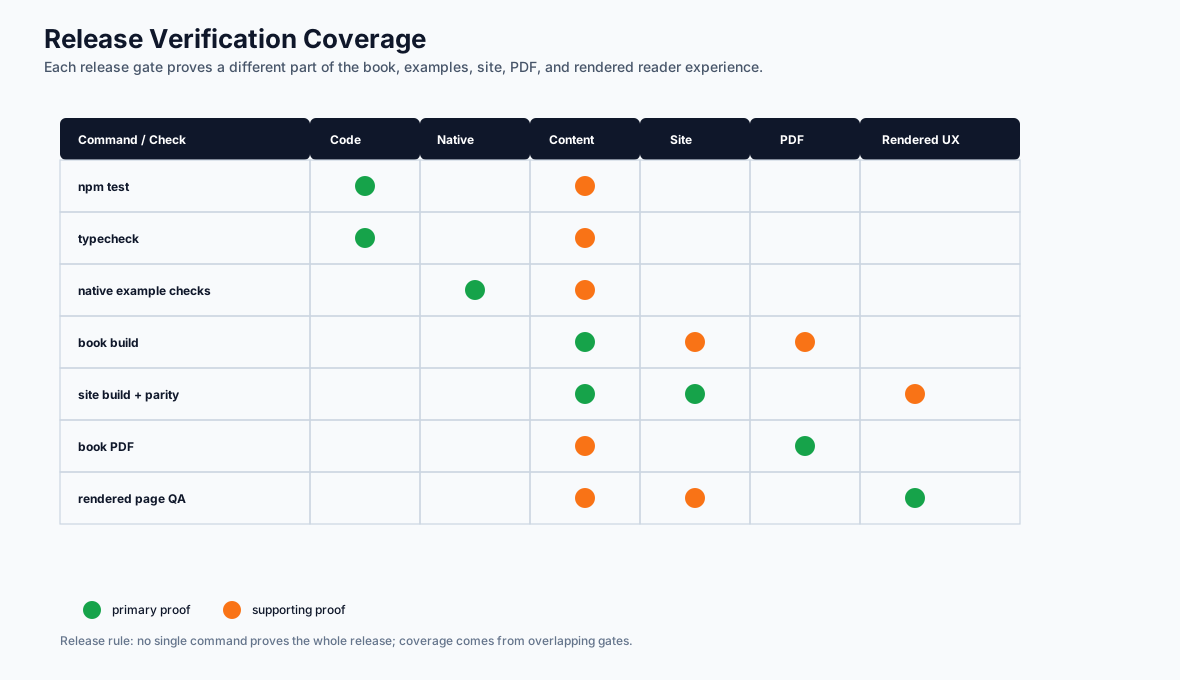
Use this graph to see why release readiness needs overlapping checks. Code tests, native example checks, content builds, site parity, courtesy format generation, and rendered-page QA each prove a different part of the release.
Reader Journey
| Gate | Release Evidence |
|---|---|
| Start path is coherent | How To Read This Book gives first-time, builder, lab, capstone, and reference paths. |
| Pattern selection is usable | Selection chapters explain when to use a pattern, when to avoid it, and how patterns compose. |
| Labs prove architecture, not only APIs | Labs identify language, framework, source files, baseline command, production gap, and expected output. |
| Mini-framework track explains the primitives | The from-scratch track shows loop, decision, tool registry, policy, memory, trace, and eval responsibilities. |
| Capstones feel product-shaped | Capstones include state, policy, memory, approvals, traces, evals, ADRs, runbooks, rollback, and framework mappings. |
Content Quality
| Gate | Release Evidence |
|---|---|
| No unfinished markers | Search for common draft markers outside generated assets. |
| Diagrams have context | Architecture diagrams are introduced by the ownership boundary or decision they explain. |
| Tables are not orphaned | Tables have enough context before and after them to explain how the reader should use the rows. |
| Examples name their limits | Demo code states what production still needs: state, policy, tracing, evals, approval, deployment, or framework integration. |
| Terminology is stable | State, policy, memory, tools, traces, evals, workflows, and approvals mean the same thing across chapters. |
Chapter A++ Spot Check
Before publishing, select at least one chapter from each changed section and check it against the book’s editorial bar. A chapter is release-ready when it gives the reader a decision, boundary, test, or reusable artifact, not just more information.
| Check | Release Evidence |
|---|---|
| Reader promise is clear | The first screen says what problem the chapter solves and why it matters. |
| Use and avoid cases are explicit | The chapter helps a reader choose the pattern or reject it. |
| Ownership is visible | State, tools, policy, memory, approvals, evals, and stop conditions have owners. |
| Failure modes are concrete | The chapter names realistic ways the design can fail and how to detect them. |
| Production gap is named | The chapter explains what changes before real users, data, money, or side effects. |
| Evaluation is actionable | The reader can turn the guidance into a test, eval case, fixture, or release gate. |
| Reuse artifact exists | The chapter leaves a checklist, schema, trace shape, worksheet, ADR, or implementation pattern. |
| Online UX works | Headings, tables, diagrams, code blocks, links, and downloads are readable in the built site. |
If a changed chapter fails more than two checks, do not treat it as an A++ change. Revise the chapter or record the limitation in the release notes.
Verification Commands
Run these from the repository root:
npm test
npm run release:commands
npm run typecheck
npm run capstones:evidence
npm run native-examples:validate
npm run native-examples:smoke:langgraph
npm run book:manifest:test
npm run book:visuals:verify
npm run book:quality
npm run book:build
npm run site:build
npm run site:parity
npm run book:pdf
npm run book:epub
Expected evidence:
| Command | What It Proves |
|---|---|
npm test |
Deterministic pattern examples, labs, capstones, evidence gates, and protocol examples still run. |
npm run release:commands |
Package scripts, release docs, and the publish workflow list the same release gates. |
npm run typecheck |
TypeScript examples and shared contracts still compile. |
npm run capstones:evidence |
Capstone chapters, runtime stop reasons, trace assets, eval reports, and scorecard links agree. |
npm run native-examples:validate |
Native framework example files are syntactically valid and required assets exist. |
npm run native-examples:smoke:langgraph |
LangGraph native slices install optional dependencies and execute without provider keys. |
npm run book:manifest:test |
Sidebar, PDF manifest, chapter ownership, and generated chapter registration are valid. |
npm run book:visuals:verify |
Every manifest chapter and the homepage have a Mermaid diagram, image, or SVG reference. |
npm run book:quality |
Manifest coverage, generated chapters, title/H1 consistency, unfinished markers, diagram assets, diagram alt text, and Mermaid SVG coverage are valid. |
npm run book:build |
VitePress authoring build, generated pages, diagrams, and downloads are valid after quality gates pass. |
npm run site:build |
Astro reader site builds with synced public assets and search index. |
npm run site:parity |
Published routes and internal links match the book manifest. |
npm run book:pdf |
The courtesy PDF and deploy copy can be regenerated. |
npm run book:epub |
The courtesy EPUB and deploy copy can be regenerated. |
Visual QA
Inspect these pages in the built site before release:
/book/intro//book/publishing/how-to-read//book/pattern-selection/choosing-the-right-pattern//book/agent-engineering-practice/cross-framework-decision-matrix//book/hands-on-labs//book/hands-on-labs/from-scratch-mini-framework//book/capstone-projects//book/systems-architecture/reference-architecture//book/publishing/release-notes/
Check that diagrams render, headings fit, code blocks are readable, tables do not feel unexplained, and navigation keeps the reader oriented.
Public URL QA
After deployment to GitHub Pages, inspect the public site with the production base path:
| Public URL | Check |
|---|---|
/Agentic-Systems-Patterns/ |
Homepage renders and primary actions work. |
/Agentic-Systems-Patterns/book/intro/ |
Introduction loads from the deployed site. |
/Agentic-Systems-Patterns/book/publishing/how-to-read/ |
Reader paths are reachable. |
/Agentic-Systems-Patterns/book/pattern-selection/choosing-the-right-pattern/ |
Core pattern selection page loads. |
/Agentic-Systems-Patterns/book/hands-on-labs/ |
Lab index loads and lab links resolve. |
/Agentic-Systems-Patterns/book/capstone-projects/ |
Capstone index loads and artifact links resolve. |
/Agentic-Systems-Patterns/releases/Agentic-Systems-Patterns.pdf |
Courtesy PDF downloads. |
/Agentic-Systems-Patterns/releases/Agentic-Systems-Patterns.epub |
Courtesy EPUB downloads. |
/Agentic-Systems-Patterns/pagefind/ |
Search assets exist, search returns results, and level/type filters work. |
Local build checks prove the deployable artifact. Public URL QA proves the deployed reader surface.
Download And Asset QA
Check the reader-facing assets that make the online book useful:
| Asset | Release Evidence |
|---|---|
| Courtesy PDF | /releases/Agentic-Systems-Patterns.pdf exists and reflects the current content. |
| Courtesy EPUB | /releases/Agentic-Systems-Patterns.epub exists and reflects the current content. |
| Source bundles | Pattern, lab, native framework, and capstone downloads resolve from the built site. |
| Templates | Worksheets, scorecards, and review checklists resolve under /capstone-assets/templates/. |
| Completed examples | Completed ADR, lab evidence, and production-readiness examples resolve under /capstone-assets/templates/. |
| Trace examples | Capstone trace JSON files resolve and match the chapter references. |
| Eval reports | Capstone eval report files resolve and match the chapter references. |
| Capstone evidence gate | npm run capstones:evidence passes against chapter text, runtime output, trace assets, eval reports, and scorecard links. |
| Diagrams | SVG diagrams render on chapter pages and are not orphaned. |
| Search metadata | Pagefind reports chapter filters and rendered search results show section, type, and level metadata. |
This check matters because the book is an online product. A chapter can read well and still fail readers if its downloads or evidence artifacts are missing.
Release Evidence Record
Before publishing, record:
version:
date:
commit:
commands passed:
visual pages checked:
download assets checked:
known limitations:
release owner:
rollback action:
Put the record in the release notes, GitHub release, or release PR description.
Use the downloadable release evidence record when the release changes reader-facing content or publishing behavior. The current release already has a filled pre-launch release evidence record; complete its public GitHub Pages section after deployment.
Release Decision
Do not publish if any of these are true:
- A required command fails.
- A core reader path contains a broken link or missing image.
- A lab points to source code that no longer exists.
- A capstone claims native framework coverage that has no matching example or clear scope.
- The courtesy PDF or EPUB is stale relative to the site content.
- Release notes do not say what changed and how it was verified.
Publish only when the release evidence is stronger than the claim made to readers.