Choosing Multi-Agent Topology
Do not start a design by asking how many agents you need.
Start by asking where the work needs separate context, separate tools, separate authority, separate timing, or separate accountability. If those boundaries are real, multiple agents can help. If those boundaries are not real, multiple agents usually add cost, latency, and failure modes.
Multi-agent design is not about making the system look more intelligent. It is about creating useful boundaries.
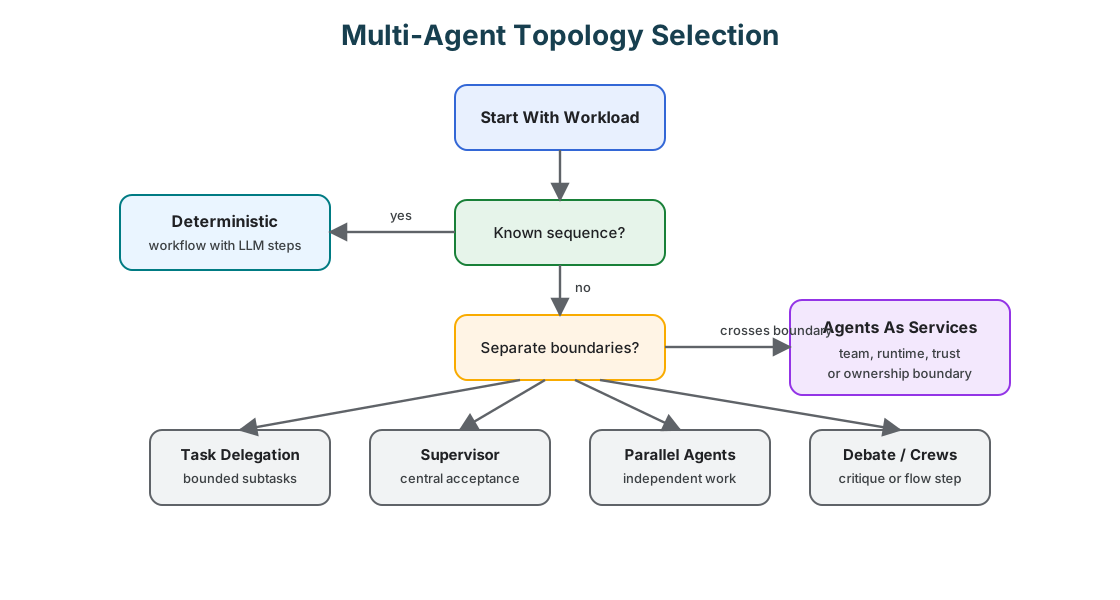
The default should still be conservative. Multi-agent design is a coordination tradeoff, not an intelligence upgrade. Every extra agent adds protocol surface, context selection, tool permissions, traces, latency, cost, failure modes, and ownership questions. Add an agent only when the boundary it creates is worth that cost.
First Rule
Use the smallest topology that gives you the boundary you need.
Many systems do not need multiple agents. They need:
- a deterministic workflow;
- one agent loop with better tools;
- routing between workflows;
- a reviewer step;
- stronger context management;
- better evals;
- better observability.
Multiple agents are justified when one agent would have to carry too much context, too much authority, too many tools, or too many conflicting responsibilities.
When To Split Agents
Split agents for engineering reasons, not because the problem sounds complex.
Good reasons to split:
- Ownership: different teams own different capabilities, policies, releases, or incidents.
- Context: each part needs a different working set and should not see everything.
- Authority: one part can read data, another can draft actions, and another can approve side effects.
- Tools: tool sets are different enough that sharing them would increase risk.
- Timing: some work is interactive, some is asynchronous, and some waits for approval.
- Scaling: one capability needs different deployment, latency, cost, or model routing.
- Evaluation: each capability can be tested with its own fixtures and acceptance criteria.
Bad reasons to split:
- the single-agent prompt is messy;
- the team hopes more agents will compensate for unclear goals;
- every agent will receive the same context and tools;
- no one can define the handoff contract;
- the merge policy is “the model will figure it out”;
- there is no trace across handoffs.
If the split does not create a clearer boundary, it is probably hiding weak architecture.
Topology Decision Matrix
| Situation | Prefer | Avoid |
|---|---|---|
| Known sequence with clear rules | Deterministic workflow | Multi-agent chat. |
| One task needs specialist decomposition | Task delegation | One general agent with a giant prompt. |
| Central owner must control quality and merge results | Supervisor-worker | Peer agents with no final owner. |
| Independent work can run concurrently | Parallel agents | Sequential agent chains that waste time. |
| Output improves through critique or comparison | Debate and consensus | Voting without evidence or tests. |
| Workflow state matters more than agent chatter | Flow with crews | Crew as substitute for state design. |
| Agents cross team, runtime, or trust boundaries | Agents as services over A2A, MCP, events, or workflows | Unstructured natural language handoffs. |
| Agents need asynchronous coordination over time | Board, queue, durable workflow, or task ledger | Shared context windows and manual copy-paste. |
The right topology is usually boring. That is a feature.
| Topology | Best For | Main Cost | Required Control |
|---|---|---|---|
| Single agent | One bounded task with one tool/policy surface. | Limited specialization. | Strong loop state, budget, and tool policy. |
| Workflow with agent steps | Known process with uncertain substeps. | Workflow design effort. | Durable state and explicit transitions. |
| Supervisor-worker | Specialist work with one final owner. | Coordination and merge complexity. | Typed assignments and merge gate. |
| Parallel agents | Independent work that benefits from concurrency. | Higher spend and trace volume. | Fan-in reducer and per-worker evidence. |
| Debate or consensus | Ambiguous judgment that benefits from critique. | Latency and false confidence. | Evidence-backed judge and accountable owner. |
| Agents as services | Team, runtime, security, or deployment boundaries. | Service contracts and versioning. | API/A2A/MCP contract, auth, ownership, evals. |
| A2A interoperability | Remote agent collaboration across boundaries. | Protocol and lifecycle complexity. | Message envelope, scopes, idempotency, traces. |
A topology selector should encode the same bias:
interface WorkloadShape {
  knownSequence: boolean;
  independentSubtasks: boolean;
  needsSpecialists: boolean;
  needsCentralAcceptance: boolean;
  benefitsFromCritique: boolean;
  crossesTrustBoundary: boolean;
}

function chooseTopology(workload: WorkloadShape) {
  if (workload.knownSequence && !workload.needsSpecialists) {
    return 'deterministic_workflow';
  }

  if (workload.crossesTrustBoundary) {
    return 'agents_as_services';
  }

  if (workload.independentSubtasks && workload.needsCentralAcceptance) {
    return 'supervisor_worker';
  }

  if (workload.independentSubtasks) {
    return 'parallel_agents';
  }

  if (workload.benefitsFromCritique) {
    return 'debate_and_consensus';
  }

  return 'single_agent_or_workflow';
}
The point is not to automate architecture. The point is to make the selection criteria visible enough to argue with.
Topology Contract
Before implementation, write down the topology contract. It can be lightweight, but it should be explicit:
type TopologyContract = {
  topology:
    | 'single_agent'
    | 'workflow_with_agent_steps'
    | 'supervisor_worker'
    | 'parallel_agents'
    | 'debate_consensus'
    | 'agents_as_services'
    | 'a2a_interoperability';
  owner: string;
  reasonForSplit: string;
  agents: Array<{
    name: string;
    capability: string;
    ownsState: string[];
    allowedTools: string[];
    forbiddenTools: string[];
    contextRefs: string[];
    requiredScopes: string[];
  }>;
  handoffContract: {
    protocol: 'internal_call' | 'REST' | 'gRPC' | 'MCP' | 'A2A' | 'queue' | 'workflow';
    inputSchema: string;
    outputSchema: string;
    timeoutMs: number;
    idempotencyRequired: boolean;
  };
  evaluation: {
    baseline: 'single_agent' | 'deterministic_workflow';
    successMetrics: string[];
    coordinationMetrics: string[];
  };
};
The contract forces the key question: what does the topology buy that a simpler design does not?
Declare The Topology Before You Code It
A multi-agent system should have a visible topology before it has framework glue. Write down:
- agents and their responsibilities;
- allowed communication paths;
- fan-out and fan-in points;
- gates and approval boundaries;
- shared state and private state;
- failure and cancellation behavior.
This can be a diagram, a table, or a small declarative file. The important property is reviewability: a reader should understand the agent graph without reverse-engineering callbacks and prompts.
Deterministic Workflow First
If code can own the sequence, let code own the sequence.
Use a deterministic workflow when:
- the steps are known;
- branching rules are clear;
- correctness depends on policy or business rules;
- state transitions must be auditable;
- latency and cost matter;
- human approval must pause the process.
The model can still be useful inside the workflow. It can classify, extract, summarize, draft, rank, or critique. But the workflow owns the path.
Task Delegation
Use task delegation when the work decomposes into bounded subtasks.
Good delegation has:
- clear subtask contracts;
- scoped context for each worker;
- expected output shape;
- acceptance criteria;
- one owner for final merge;
- evals that prove decomposition helps.
Bad delegation is just asking several agents to “work on this” and hoping the combined answer is better.
Supervisor-Worker
Use supervisor-worker when a central agent or workflow must own the goal, state, routing, and final acceptance.
This topology is useful when:
- workers have different tools or context;
- the supervisor can evaluate worker outputs;
- there is one accountable final answer;
- some worker failures should not fail the whole task;
- workers must not see each other’s full context.
The supervisor should not become a hidden god agent. It should own coordination, not every detail of execution.
Parallel Agents
Use parallel agents when work is independent and the merge policy is clear.
Good cases:
- search multiple sources;
- generate several candidate plans;
- review the same artifact from different angles;
- run separate checks such as security, correctness, and style;
- compare outputs from different models or prompts.
Parallelism is not free. It increases cost, trace volume, and merge complexity. Use it when it buys latency reduction, quality lift, or independent coverage.
Debate And Consensus
Use debate or consensus when independent critique improves judgment.
It is useful for:
- ambiguous decisions;
- design reviews;
- risk analysis;
- comparing candidate answers;
- exposing weak assumptions.
It is weak for:
- factual questions that need retrieval;
- tool decisions that need policy;
- tasks where every agent shares the same blind spot;
- high-risk actions where voting replaces authority.
Consensus is not proof. It is a signal that still needs evidence, tests, or an accountable owner.
Crews And Flows
Use crews inside flows when the workflow needs explicit state and a group of specialized agents performs one bounded step.
The flow should own:
- state;
- event order;
- retries;
- approvals;
- persistence;
- stop conditions.
The crew should own:
- local collaboration;
- specialist roles;
- bounded output for one workflow step.
If crew-local chat becomes the state machine, the architecture is weak.
Agents As Services
When agents cross process, team, runtime, vendor, or trust boundaries, treat them like services.
That means:
- explicit capability contract;
- typed request and response;
- authentication;
- authorization;
- timeouts;
- idempotency;
- refusal semantics;
- cancellation;
- trace correlation;
- versioning;
- contract tests.
The protocol may be A2A, MCP, REST, gRPC, event streams, or a durable workflow engine. The important thing is not the protocol brand. The important thing is that the boundary is explicit and testable.
This is where the microservices analogy is useful. Splitting agents is reasonable when it creates clearer ownership, contracts, deployment, security, scaling, and observability. It is not reasonable when it only turns one vague agent into several vague agents.
Use A2A or service-style communication when the remote agent has its own lifecycle: capability discovery, authorization, progress, refusal, cancellation, versioning, and trace ownership. Use MCP when the boundary is primarily a tool or capability. Use workflows when state and approvals matter more than direct agent-to-agent messaging.
Board, Queue, Or Ledger Coordination
Some multi-agent work should not be coordinated through direct chat.
Use a board, queue, task ledger, or durable workflow when:
- work happens asynchronously;
- humans and agents both participate;
- decisions need to stay attached to work items;
- agents run in separate sessions;
- progress must survive restarts;
- handoffs need audit history.
This is especially useful for coding agents, operations agents, research pipelines, and long-running review workflows.
Shared State
Shared state is where multi-agent systems often fail.
Avoid:
- every agent writing to the same memory;
- hidden shared scratchpads;
- unversioned summaries;
- agents overwriting each other’s conclusions;
- state stored only in conversation history.
Prefer:
- one owner for each state object;
- append-only task logs;
- explicit merge steps;
- durable workflow state;
- typed artifacts;
- human-readable handoff records;
- trace IDs across agents.
If shared state is unclear, the topology is not ready.
Handoffs And Ownership
Every handoff should answer three questions:
- Who owns the task now?
- What exactly was handed off?
- What condition returns ownership, escalates, or stops the run?
Without ownership, multi-agent systems become distributed ambiguity. A worker can be useful only if the caller knows what the worker accepted, refused, completed, or could not decide. That means handoffs need schemas, status values, stop reasons, and traces.
Evaluation Guidance
A multi-agent system should beat a simpler baseline.
Evaluate:
- single-agent baseline versus multi-agent topology;
- quality lift;
- latency cost;
- token and tool cost;
- merge accuracy;
- worker failure handling;
- disagreement handling;
- trace completeness;
- permission isolation;
- context isolation;
- final accountability.
Measure coordination as a first-class cost:
| Metric | Why It Matters |
|---|---|
| Handoff correctness | Proves work is routed to the right agent with the right contract. |
| Coordination overhead | Shows whether extra agents spend more effort than they save. |
| Merge quality | Proves the final answer preserves evidence and disagreement. |
| Ownership clarity | Shows whether failures have an accountable component. |
| Trace completeness | Makes distributed failures debuggable. |
| Tool isolation | Proves agents cannot use tools outside their role. |
| Context isolation | Proves agents do not receive irrelevant or unsafe context. |
| Cost and latency by topology | Shows whether the topology is operationally worth it. |
Include negative evals where the system should choose a simpler topology. A good topology selector should know when not to use multiple agents.
Failure Modes
- Multi-agent design is used to hide unclear goals or weak state.
- Every agent gets the same context, tools, memory, and permissions.
- Workers can create side effects without supervisor, policy, or approval checks.
- Handoffs are natural-language blobs with no schema or owner.
- Agents delegate tasks back and forth with no delegation budget.
- Debate produces agreement but no evidence.
- Parallel agents duplicate work because boundaries are unclear.
- Agents as services have no versioned contract, auth, or idempotency rule.
- The final answer hides worker failure, disagreement, or missing evidence.
- There is no trace that connects assignments, handoffs, worker outputs, merge decisions, and stop reason.
Design Checklist
Before adding another agent, answer:
- What boundary does this new agent create?
- Does it need separate context?
- Does it need separate tools?
- Does it need separate permissions?
- Does it need independent timing?
- Who owns final acceptance?
- How are outputs merged?
- What happens if this agent fails, refuses, or times out?
- What state does it own?
- What context must it never see?
- What protocol or contract governs the handoff?
- What prevents delegation loops?
- What is the simpler baseline?
- How do traces connect across agents?
- What eval proves this topology is better than the simpler baseline?
If the only reason for another agent is “it feels more agentic,” do not add it.