Reflection
Reflection asks an agent or evaluator to inspect prior output and identify concrete improvements.
Source and downloads
Intent
Reflection asks an agent or evaluator to inspect prior output and identify concrete improvements.
Use When
- The system has explicit quality criteria.
- A critique can change decisions, tests, state, or final artifacts.
- You need a lightweight improvement pass without a full evaluator-optimizer loop.
Avoid When
- The critique only produces longer output.
- There is no acceptance criterion for the revised result.
- The model is asked to approve its own unsafe actions.
Architecture
Use this diagram to read Reflection as a system boundary, not only a code shape. The key ownership question is: the loop controller owns progress, budgets, stop conditions, and recovery state.
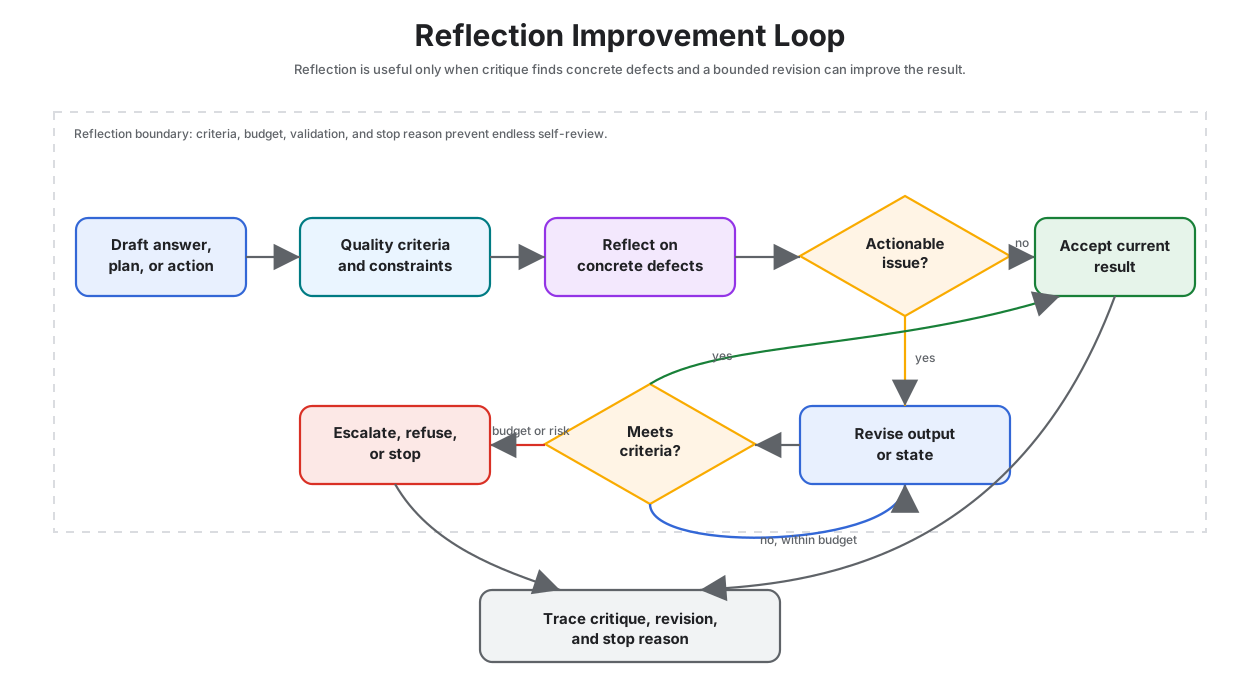
Read it as a bounded improvement pass: critique must identify concrete defects, revision must be validated, and budget or risk must stop the loop.
System Shape
- Pattern boundary: a controller repeatedly chooses the next step, executes it, observes the result, and decides whether to continue.
- State owner: the loop controller owns progress, budgets, stop conditions, and recovery state.
- Primary artifact:
reflection-and-self-improvement-pattern/contains the runnable reference implementation and examples. - Operational promise: Reflection asks an agent or evaluator to inspect prior output and identify concrete improvements.
- Runnable path: start with
npm run reflection-self-improvement-agentbefore adapting the pattern to a larger system.
Core Protocol
- Initialize goal state, constraints, budgets, and stop conditions.
- Choose the next action from the current state instead of assuming the whole path upfront.
- Execute the action through a validated tool, worker, or local function.
- Observe the result and update state with evidence, errors, and remaining work.
- Stop, retry, re-plan, or escalate according to explicit policy.
Implementation Notes
- Keep the pattern boundary explicit: inputs, state, side effects, and outputs should be visible.
- Validate model-produced decisions before they affect tools, users, or durable state.
- Emit enough trace data to debug failures after the run.
Failure Modes
- The pattern is applied where a simpler deterministic workflow would be better.
- State, tool calls, or model decisions are not observable enough to debug.
- The system lacks clear stop, retry, or escalation behavior.
Evaluation Strategy
- Test success cases, partial failure, repeated failure, budget exhaustion, and bad intermediate observations.
- Assert that the loop stops for the right reason and does not hide failed steps.
- Measure completion rate, number of iterations, recovery quality, cost, and latency.
- Include cases that prove each “Use When” condition is true for this pattern.
- Include negative cases from “Avoid When” so the system chooses a simpler or safer pattern when appropriate.
Production Checklist
- Set hard iteration, cost, and time limits.
- Persist state after meaningful steps if the run can be interrupted.
- Make retries idempotent or add compensation.
- Expose trace events for each decision, action, observation, and stop reason.
- Define human escalation for ambiguous, high-risk, or policy-blocked work.
- Keep the source bundle, generated chapter, tests, and deployment artifact in the same release.
Run the Example
npm run reflection-self-improvement-agent
Code Walkthrough
Read the excerpt as the smallest executable expression of the pattern. The surrounding chapter explains the design constraints; the code shows where those constraints become concrete interfaces, state, validation, or control flow.
Source Code
These excerpts show the implementation shape. The complete code is available in the download bundle and repository source.
reflection-and-self-improvement-pattern/autogen_typescript_example/reflection_agent.ts
import dotenv from 'dotenv';
dotenv.config();
import axios from 'axios';
import readline from 'readline';

const MISTRAL_API_KEY = process.env.MISTRAL_API_KEY;
const MISTRAL_API_URL = 'https://api.mistral.ai/v1/chat/completions';

if (!MISTRAL_API_KEY) {
  console.error('Please set MISTRAL_API_KEY in your .env file');
  process.exit(1);
}

async function askMistral(messages: any[]) {
  const response = await axios.post(
    MISTRAL_API_URL,
    {
      model: 'mistral-tiny',
      messages,
    },
    {
      headers: {
        'Authorization': `Bearer ${MISTRAL_API_KEY}`,
        'Content-Type': 'application/json',
      },
    }
  );
  return response.data.choices[0].message.content.trim();
}

async function main() {
  const rl = readline.createInterface({
    input: process.stdin,
    output: process.stdout,
  });

  rl.question('Ask the agent a question: ', async (userInput) => {
    let messages = [
      { role: 'system', content: 'You are a helpful assistant that reflects on your answers and tries to improve them if possible.' },
      { role: 'user', content: userInput },
    ];

    // First response
    let answer = await askMistral(messages);
    console.log('\nInitial Answer:\n', answer);

    // Reflection step
    messages.push({ role: 'assistant', content: answer });
    messages.push({ role: 'system', content: 'Reflect on your previous answer. Was it correct, clear, and complete? If not, revise and improve it.' });
    let reflection = await askMistral(messages);
    console.log('\nReflected/Improved Answer:\n', reflection);

    rl.close();
  });
}

main();
reflection-and-self-improvement-pattern/langgraph_python_example/reflection_agent.py
import os
import requests

def ask_mistral(messages):
    api_key = os.getenv('MISTRAL_API_KEY')
    if not api_key:
        raise ValueError('Please set MISTRAL_API_KEY in your .env file')
    url = 'https://api.mistral.ai/v1/chat/completions'
    headers = {
        'Authorization': f'Bearer {api_key}',
        'Content-Type': 'application/json',
    }
    data = {
        'model': 'mistral-tiny',
        'messages': messages,
    }
    response = requests.post(url, headers=headers, json=data)
    response.raise_for_status()
    return response.json()['choices'][0]['message']['content'].strip()

def main():
    user_input = input('Ask the agent a question: ')
    messages = [
        {'role': 'system', 'content': 'You are a helpful assistant that reflects on your answers and tries to improve them if possible.'},
        {'role': 'user', 'content': user_input},
    ]
    # First response
    answer = ask_mistral(messages)
    print('\nInitial Answer:\n', answer)
    # Reflection step
    messages.append({'role': 'assistant', 'content': answer})
    messages.append({'role': 'system', 'content': 'Reflect on your previous answer. Was it correct, clear, and complete? If not, revise and improve it.'})
    reflection = ask_mistral(messages)
    print('\nReflected/Improved Answer:\n', reflection)

if __name__ == '__main__':
    main()
Download
The download bundle contains the current reflection-and-self-improvement-pattern/ folder from this repository.