Lab Framework and Language Matrix
The labs are intentionally language- and framework-agnostic. They use different tools so you can see the architectural pattern beneath the framework API.
Use this page before you start coding. It answers two questions: which lab should I run first, and what production boundary should I inspect while I run it?
Coverage Graph
Use this graph to see the learning emphasis across languages, runtimes, framework slices, and capstones. The goal is balanced architecture exposure, not equal package coverage.
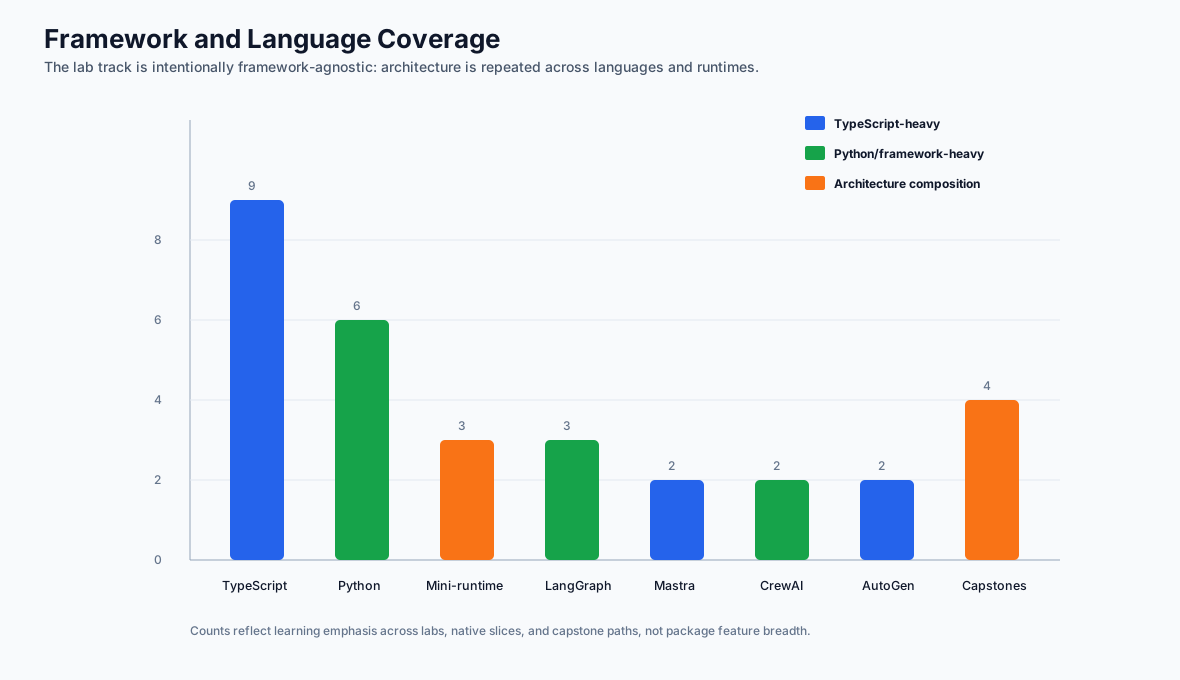
| Lab | Pattern | Language | Framework / Runtime | Framework-Agnostic Lesson |
|---|---|---|---|---|
| Lab 01 - Tool-Using Agent | Tool use | TypeScript | Minimal custom runtime / AutoGen-style example | The model proposes a capability use; software owns validation and execution. |
| Lab 02 - Agent Loop and Planning | Planning and execution | TypeScript, with Python mirror | Framework-neutral planner/executor | Planning and execution are separate responsibilities even when one framework packages both. |
| Lab 03 - Agentic RAG | Retrieval and grounding | Python | LangChain/LangGraph-style retrieval stack | Retrieval produces scoped evidence; generation must stay grounded in that evidence. |
| Lab 04 - A2A Communication | Agent-to-agent protocol | TypeScript | Protocol-first runtime with Ajv schema validation | Agent communication needs typed envelopes, correlation IDs, refusals, errors, and cancellation. |
| Lab 05 - Multi-Agent Supervisor | Supervisor / worker | TypeScript | AutoGen-style manager/worker example | A supervisor owns decomposition, worker contracts, and final synthesis. |
| Lab 06 - Observability and Evals | Trace and eval harness | TypeScript | Framework-neutral tests over examples | Evals should inspect trajectories, not only final answers. |
| Lab 07 - Mastra Runtime Packaging | Runtime packaging | TypeScript | Mastra-style agents, tools, workflows, memory, and evals | Framework runtime packaging does not remove product ownership of state, policy, and acceptance. |
| Lab 08 - CrewAI Flows and Crews | Flow and crew orchestration | Python | CrewAI-style flows, crews, roles, and tasks | Flows own state and acceptance; crews perform bounded specialist work. |
| Mini-Framework Track | Runtime primitives | TypeScript or Python | From-scratch educational runtime | Building the primitives once clarifies what frameworks package. |
| Lab 09 - Minimal Agent Loop | Agent loop | TypeScript or Python | From-scratch educational runtime | State, decisions, observations, budgets, and stop reasons are the core loop. |
| Lab 10 - Tool Registry and Policy Gate | Tool and policy boundary | TypeScript or Python | From-scratch educational runtime | Tool availability and policy authorization are different runtime decisions. |
| Lab 11 - Context, Memory, Trace, and Evals | Runtime observability | TypeScript or Python | From-scratch educational runtime | Context, memory, traces, and trajectory evals make the runtime reviewable. |
| Lab 12 - LangGraph State Graph | State graph and resume | Python | LangGraph-style graph state, nodes, edges, checkpoints, and interrupts | Graph execution is strongest when state, branching, pause/resume, and node observability matter. |
| Lab 13 - AutoGen Transcript Evals | Multi-agent transcript evaluation | TypeScript | AutoGen-style agents, teams, messages, and transcript evals | A multi-agent run needs a reviewable transcript, explicit stop reason, and role-level acceptance criteria. |
How To Read The Matrix
Do not treat the framework column as the point of the lab. Treat it as the implementation surface. The durable lesson is the boundary: state, tools, policy, context, communication, evaluation, or runtime control.
If you later use LangGraph, Mastra AI, AutoGen, CrewAI, Semantic Kernel, MCP, or a custom runtime, keep the same questions in view:
- What does the framework own?
- What does your application still own?
- Where is state persisted?
- Where are tool calls validated?
- Where is policy enforced?
- What can be replayed after a failure?
Choose By Situation
Use this table when you already know the problem you are trying to solve.
| If Your Current Problem Is… | Start With | Then Read | Why |
|---|---|---|---|
| Exposing one tool to a model | Lab 01 | Tool Capability Design | You need typed inputs, controlled errors, and permission boundaries before autonomy. |
| Adding planning or step-by-step execution | Lab 02 | Planning and Execution | You need to separate plan creation, execution, and stop reasons. |
| Grounding answers in documents | Lab 03 | Semantic Recall and RAG | You need source eligibility, retrieval quality, citations, and missing-evidence behavior. |
| Connecting agents or services | Lab 04 | A2A Agent Interoperability | You need typed envelopes, identity, refusals, errors, cancellation, and replay. |
| Splitting work across roles | Lab 05 | Supervisor / Worker | You need worker contracts, merge policy, and one final owner. |
| Proving behavior with traces and evals | Lab 06 | Observability and Evals | You need trajectory evidence, not just final answers. |
| Comparing framework runtime packaging | Lab 07 | Framework Selection | You need to see what a runtime packages and what your product still owns. |
| Modeling crew-style orchestration | Lab 08 | Choosing Multi-Agent Topology | You need to distinguish flow state from role-based worker output. |
| Understanding what frameworks package | Mini-Framework Track | Building a Minimal Agent Runtime | You need the primitives before comparing framework abstractions. |
| Testing resume, interrupts, or graph state | Lab 12 | Durable Workflows | You need checkpoints, state transitions, and failure recovery. |
| Evaluating multi-agent conversations | Lab 13 | Debate and Consensus | You need transcript evidence, role acceptance, and stop conditions. |
If several rows apply, start with the riskiest boundary. A write-capable tool, private data source, long-running workflow, or multi-agent handoff should drive the lab choice.
Fast Decision Shortcut
Use this shortcut when you have five minutes and need a starting path.
| Highest Risk In Your System | Run First | Add Next | Production Check |
|---|---|---|---|
| A model can call a tool | Lab 01 | Lab 10 | Tool schema, permission, idempotency, timeout, and audit record. |
| A model can plan several steps | Lab 02 | Lab 09 | Stop reason, budget, retry rule, cancellation, and trace events. |
| A model answers from documents | Lab 03 | Lab 11 | Source ACLs, freshness, citations, missing-evidence behavior, and retrieval evals. |
| Agents exchange messages | Lab 04 | Lab 13 | Typed envelope, identity, correlation ID, refusal, cancellation, and transcript replay. |
| Work splits across roles | Lab 05 | Lab 08 | Worker contract, merge policy, final owner, role permissions, and acceptance eval. |
| Release quality is unclear | Lab 06 | Lab 11 | Trace contract, negative cases, trajectory evals, and blocking thresholds. |
| Work can pause and resume | Lab 12 | Durable Workflows chapter | Checkpoint store, interrupt payload, state migration, and stuck-run dashboard. |
| Framework choice is unclear | Mini-Framework Track | Lab 07 | Ownership split between framework runtime and product policy. |
Do not optimize for the most interesting lab. Optimize for the boundary most likely to hurt users, leak data, spend money, or block operators.
Lab-To-Product Paths
Use these paths when you want a lab to become design-review material.
| Product Slice | Run | Compare With | Finish With |
|---|---|---|---|
| Support refund agent | Lab 01, Lab 07, Lab 12 | native-framework-examples/mastra-refund/, native-framework-examples/langgraph-refund/ |
Support Refund Agent Capstone |
| Research RAG assistant | Lab 03, Lab 06, Lab 11 | native-framework-examples/langgraph-research-rag/ |
Research RAG Agent Capstone |
| Multi-agent delivery workflow | Lab 05, Lab 08, Lab 13 | native-framework-examples/autogen-delivery/, native-framework-examples/crewai-delivery/ |
Multi-Agent Delivery Workflow Capstone |
| Custom runtime foundation | Labs 09, 10, 11 | Mini-framework TypeScript or Python implementation | Reference Architecture |
Each path should end with a worksheet, not just a passing command. Use the lab completion worksheet, then the lab production readiness worksheet.
Current Coverage
The current labs now cover TypeScript, Python, protocol boundaries, framework-neutral tests, LangGraph-style state graphs, AutoGen-style transcripts, Mastra-style runtime packaging, CrewAI-style flow orchestration, from-scratch runtime primitives, production readiness gates, and isolated native framework examples.
Repository native examples:
| Example | Framework | Connects To |
|---|---|---|
native-framework-examples/langgraph-refund/ |
LangGraph | Lab 12 and Support Refund Agent capstone |
native-framework-examples/langgraph-research-rag/ |
LangGraph | Lab 03 and Research RAG Agent capstone |
native-framework-examples/mastra-refund/ |
Mastra | Lab 07 and Support Refund Agent capstone |
native-framework-examples/autogen-delivery/ |
AutoGen | Lab 13 and Multi-Agent Delivery Workflow capstone |
native-framework-examples/crewai-delivery/ |
CrewAI | Lab 08 and Multi-Agent Delivery Workflow capstone |
Planned lab expansion should add:
- deeper deployment walkthroughs that connect the readiness checklist to concrete cloud/runtime targets.
Matrix Review Gate
Before adding a new lab, update this page only if the lab changes reader choice. A new lab should add at least one of these:
- a new architecture boundary;
- a missing language or runtime comparison;
- a production concern not covered by existing labs;
- a capstone path that readers can follow end to end;
- a native framework slice that clarifies what the framework owns.
Do not add labs only to cover another library. Add them when they teach a boundary that engineers need to ship safer systems.