Supervisor / Worker
Supervisor/Worker centralizes goal ownership, task state, routing, and quality gates while workers perform bounded specialist work.
Source and downloads
Intent
Supervisor / Worker is a multi-agent pattern where one coordinator owns the goal, decomposition, worker contracts, merge policy, quality gate, and final accountability. Workers perform bounded specialist tasks and return structured results with evidence, errors, and confidence.
The supervisor is not just a manager-shaped prompt. It is the control point that prevents multi-agent work from becoming a group chat with no owner. It decides what work should be split, what context each worker receives, which tools each worker may use, how results are merged, and when the system must escalate.
Use When
- The task benefits from separate specialist workstreams.
- Workers can operate with scoped context, scoped tools, and clear outputs.
- The supervisor can evaluate, merge, or reject worker results.
- Parallelism, specialization, or independent review buys more than the extra coordination cost.
- One component can own final acceptance and user-facing accountability.
Avoid When
- A single agent or deterministic workflow can solve the task clearly.
- Workers would all receive the same context and tool list.
- The supervisor cannot judge whether worker output is correct.
- The merge step is vague or purely stylistic.
- Worker actions can create side effects without supervisor policy or approval.
- Nobody owns the final answer when workers disagree.
Architecture
Use this diagram to read Supervisor / Worker as a system boundary, not only a code shape. The key ownership question is: the coordinator owns the shared goal, decomposition, assignments, merge policy, and final acceptance.
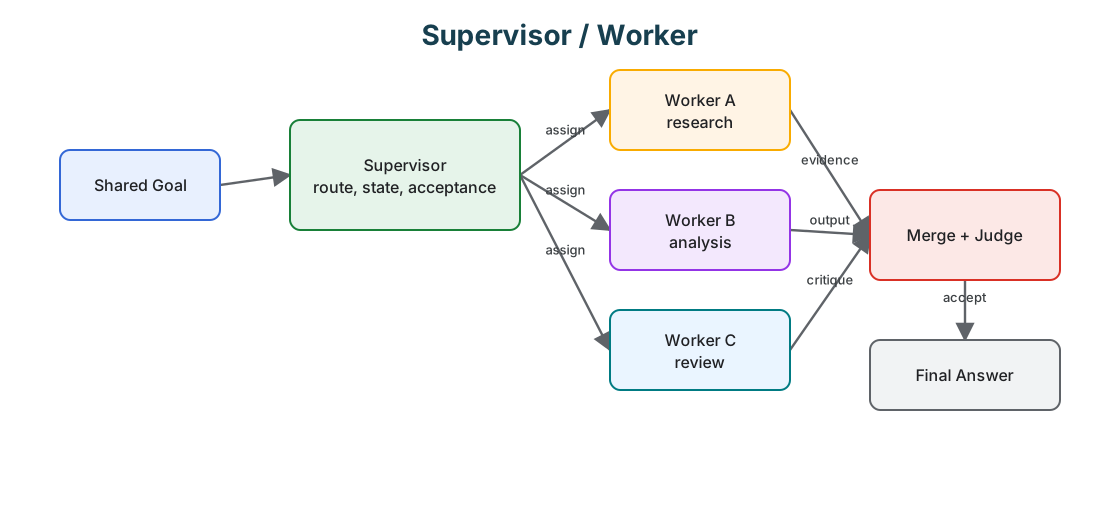
System Shape
- Pattern boundary: the supervisor owns the shared goal, decomposition, assignments, merge policy, quality checks, escalation, and final acceptance.
- Worker boundary: each worker receives a narrow task, scoped context, allowed tools, expected output schema, timeout, and acceptance criteria.
- State owner: the supervisor or workflow engine owns shared state. Workers own only task-local scratch state unless explicitly granted more.
- Policy boundary: worker tool use and side effects are constrained by the assignment, not by general worker ability.
- Operational promise: the system gets useful specialization without losing one accountable owner for the final result.
Core Protocol
- Receive the shared goal, caller, constraints, budget, and trace ID.
- Decide whether the task should be split or handled by a simpler baseline.
- Create worker assignments with scoped context, allowed tools, expected outputs, timeout, and acceptance criteria.
- Dispatch assignments and record per-worker trace IDs.
- Collect worker results, refusals, errors, timeouts, and evidence.
- Evaluate each worker result before merging.
- Merge accepted results using an explicit merge policy.
- Return, retry, reassign, or escalate with one final owner.
Implementation Notes
The handoff from supervisor to worker should be a contract, not a paragraph of instructions.
type WorkerAssignment = {
  taskId: string;
  parentTraceId: string;
  workerRole: 'policy_reviewer' | 'order_investigator' | 'customer_message_drafter';
  objective: string;
  scopedContextRefs: string[];
  allowedTools: string[];
  forbiddenTools: string[];
  timeoutMs: number;
  expectedOutput: {
    schema: 'policy_findings.v1' | 'order_findings.v1' | 'message_draft.v1';
    requiredFields: string[];
  };
  acceptanceCriteria: string[];
};
The worker result should be equally structured:
type WorkerResult = {
  taskId: string;
  workerRole: string;
  status: 'succeeded' | 'refused' | 'needs_human' | 'failed' | 'timed_out';
  output?: unknown;
  evidenceRefs: string[];
  confidence: 'low' | 'medium' | 'high';
  errors: string[];
  traceId: string;
};
A small merge gate keeps the supervisor honest:
function acceptWorkerResult(result: WorkerResult) {
  if (result.status !== 'succeeded') return false;
  if (result.evidenceRefs.length === 0) return false;
  if (result.confidence === 'low') return false;
  return true;
}
The supervisor should not rubber-stamp worker output. It should check evidence, schema, confidence, disagreement, and policy before final synthesis.
Failure Modes
- The supervisor decomposes work that did not need to be split.
- Workers all receive the full context, removing the benefit of isolation.
- Workers share broad tool access, multiplying the blast radius.
- Assignments do not specify expected output, so merge becomes guesswork.
- Workers duplicate work because boundaries are unclear.
- Worker disagreement is hidden inside a smooth final answer.
- The supervisor accepts output without checking evidence or policy.
- A failed or timed-out worker silently disappears from the final answer.
- No trace connects the final result back to worker inputs, outputs, and decisions.
- Nobody owns final accountability after the supervisor has merged results.
Evaluation Strategy
Supervisor / Worker evals should prove that the topology is better than the simpler baseline and that the coordination boundary works.
- Compare against a single-agent baseline on the same tasks.
- Test a case where the system should choose not to split the task.
- Test worker timeout, worker refusal, worker failure, and malformed worker output.
- Test disagreement between workers and require visible resolution.
- Test context isolation: each worker should receive only what it needs.
- Test permission isolation: workers should not call tools outside their assignment.
- Test merge accuracy: the final result should preserve evidence and not invent consensus.
- Test final accountability: the supervisor must return one status, one owner, and one stop reason.
A compact eval fixture can make those expectations explicit:
{
  "case_id": "refund_policy_and_order_disagree",
  "goal": "Recommend whether a refund request should be approved.",
  "workers": {
    "policy_reviewer": { "status": "succeeded", "confidence": "high" },
    "order_investigator": { "status": "succeeded", "confidence": "medium" },
    "customer_message_drafter": { "status": "blocked_until_decision" }
  },
  "expected": {
    "final_status": "needs_human",
    "must_explain_disagreement": true,
    "forbidden_worker_tools": ["refunds.issue_refund", "support.send_customer_email"],
    "required_trace_events": ["assignment", "worker_result", "merge_decision", "stop"]
  }
}
Measure quality lift over baseline, latency cost, token cost, worker failure handling, merge accuracy, disagreement handling, permission isolation, context isolation, and trace completeness.
Production Checklist
- Keep one owner for the final answer.
- Require a typed worker assignment for every worker call.
- Scope context and tools per worker.
- Give each worker a timeout, cancellation rule, and refusal path.
- Record assignment, worker input, worker output, merge decision, and stop reason.
- Make disagreement visible instead of smoothing it away.
- Define when the supervisor retries, reassigns, escalates, or stops.
- Compare quality and cost against a simpler single-agent baseline.
- Keep worker prompts, tool manifests, and output schemas versioned.
- Add circuit breakers for failing workers or unsafe tool proposals.
Run the Example
npm run hierarchical-agent
Code Walkthrough
Read the excerpt as the smallest executable expression of the pattern. The surrounding chapter explains the design constraints; the code shows where those constraints become concrete interfaces, state, validation, or control flow.
Source Code
These excerpts show the implementation shape. The complete code is available in the download bundle and repository source.
hierarchical-agent-pattern/autogen_typescript_example/hierarchical_agent.ts
import dotenv from 'dotenv';
dotenv.config();
import axios from 'axios';
import readline from 'readline';

const MISTRAL_API_KEY = process.env.MISTRAL_API_KEY;
const MISTRAL_API_URL = 'https://api.mistral.ai/v1/chat/completions';

type ChatMessage = {
  role: 'system' | 'user';
  content: string;
};

function askLocalModel(messages: ChatMessage[]) {
  const systemPrompt = messages[0]?.content ?? '';
  const userPrompt = messages[messages.length - 1]?.content ?? '';

  if (systemPrompt.includes('Decompose the user goal')) {
    return [
      'Sub-task 1: Define evaluation criteria for answer quality, retrieval grounding, latency, and failure handling.',
      'Sub-task 2: Create a small test set with expected evidence, negative cases, and acceptance thresholds.',
    ].join('\n');
  }

  if (systemPrompt.includes('Worker Agent 1')) {
    return `Worker 1 result: ${userPrompt} Criteria should include citation accuracy, unsupported-claim rate, p95 latency, and visible refusal behavior.`;
  }

  if (systemPrompt.includes('Worker Agent 2')) {
    return `Worker 2 result: ${userPrompt} The test set should include grounded answers, missing-evidence questions, stale-document checks, and threshold failures.`;
  }

  return [
    'Final answer: evaluate the RAG prototype with quality, grounding, latency, and failure-handling criteria.',
    'Use a small test set with positive cases, missing-evidence cases, stale-document cases, and blocking thresholds.',
    'Accept the prototype only when worker evidence meets the supervisor policy.',
  ].join('\n');
}

async function askMistral(messages: ChatMessage[]) {
  if (!MISTRAL_API_KEY) {
    return askLocalModel(messages);
  }

  const response = await axios.post(
    MISTRAL_API_URL,
    {
      model: 'mistral-tiny',
      messages,
    },
    {
      headers: {
        'Authorization': `Bearer ${MISTRAL_API_KEY}`,
        'Content-Type': 'application/json',
      },
    }
  );
  return response.data.choices[0].message.content.trim();
}

async function main() {
  const rl = readline.createInterface({
    input: process.stdin,
    output: process.stdout,
  });

  rl.question('State the overall goal for the manager agent: ', async (goalInput) => {
    // Manager agent decomposes the goal into two sub-tasks
    const managerMessages: ChatMessage[] = [
      { role: 'system', content: 'You are a manager agent. Decompose the user goal into two sub-tasks and assign each to a worker agent.' },
      { role: 'user', content: `Goal: ${goalInput}` },
    ];
    const managerPlan = await askMistral(managerMessages);
    console.log('\nManager Agent Plan:\n', managerPlan);

    // Simulate two worker agents (for demo, just ask Mistral for each sub-task)
    const subTasks = managerPlan.match(/Sub-task [12]: (.*)/g) || [];
    const workerResults: string[] = [];
    for (let i = 0; i < subTasks.length; i++) {
      const workerMessages: ChatMessage[] = [
        { role: 'system', content: `You are Worker Agent ${i+1}. Complete the following sub-task as best as you can.` },
        { role: 'user', content: subTasks[i] },
      ];
      const workerResult = await askMistral(workerMessages);
      console.log(`\nWorker Agent ${i+1} Result:\n`, workerResult);
      workerResults.push(workerResult);
    }

    // Manager aggregates results
    const aggregationMessages: ChatMessage[] = [
Excerpt truncated for readability. Download the bundle or open the source file for the complete implementation.
hierarchical-agent-pattern/langgraph_python_example/hierarchical_agent.py
import os
import requests
import re

def ask_mistral(messages):
    api_key = os.getenv('MISTRAL_API_KEY')
    if not api_key:
        raise ValueError('Please set MISTRAL_API_KEY in your .env file')
    url = 'https://api.mistral.ai/v1/chat/completions'
    headers = {
        'Authorization': f'Bearer {api_key}',
        'Content-Type': 'application/json',
    }
    data = {
        'model': 'mistral-tiny',
        'messages': messages,
    }
    response = requests.post(url, headers=headers, json=data)
    response.raise_for_status()
    return response.json()['choices'][0]['message']['content'].strip()

def main():
    goal_input = input('State the overall goal for the manager agent: ')
    # Manager agent decomposes the goal into two sub-tasks
    manager_messages = [
        {'role': 'system', 'content': 'You are a manager agent. Decompose the user goal into two sub-tasks and assign each to a worker agent.'},
        {'role': 'user', 'content': f'Goal: {goal_input}'},
    ]
    manager_plan = ask_mistral(manager_messages)
    print('\nManager Agent Plan:\n', manager_plan)

    # Simulate two worker agents (for demo, just ask Mistral for each sub-task)
    sub_tasks = re.findall(r'Sub-task [12]: (.*)', manager_plan)
    worker_results = []
    for i, sub_task in enumerate(sub_tasks):
        worker_messages = [
            {'role': 'system', 'content': f'You are Worker Agent {i+1}. Complete the following sub-task as best as you can.'},
            {'role': 'user', 'content': sub_task},
        ]
        worker_result = ask_mistral(worker_messages)
        print(f'\nWorker Agent {i+1} Result:\n', worker_result)
        worker_results.append(worker_result)

    # Manager aggregates results
    aggregation_messages = [
        {'role': 'system', 'content': 'You are a manager agent. Aggregate the following worker results into a final answer for the user.'},
        {'role': 'user', 'content': '\n'.join([f'Worker {i+1}: {r}' for i, r in enumerate(worker_results)])},
    ]
    final_result = ask_mistral(aggregation_messages)
    print('\nFinal Aggregated Result for User:\n', final_result)

if __name__ == '__main__':
    main()
Download
The download bundle contains the current hierarchical-agent-pattern/ folder from this repository.